F-Secure and NordVPN get compared a lot, but rarely on fair terms. One is a Finnish security company that has been selling antivirus for three decades and folded VPN into a broader protection suite; the other is a VPN-first company that built a whole product ecosystem around privacy, streaming, and mesh networking. If you only compare “VPN speed” you will miss the actual reason people pick one over the other.
This comparison is built around the decision most buyers actually face: do you want a VPN as part of a security bundle, or a VPN as the center of your setup? Below we break down what each product is really selling, how the plans line up, where each one falls short, and which type of user should walk away from the other.
What each product actually is
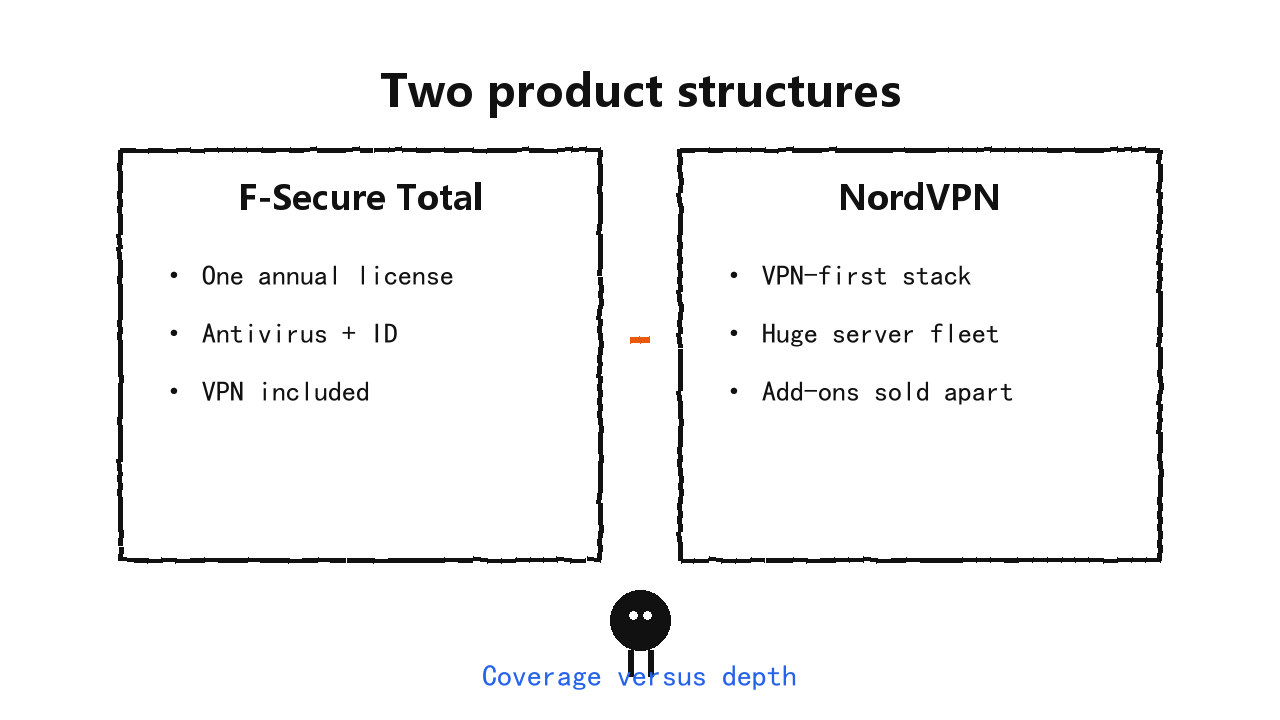
F-Secure Total is a security suite: antivirus, browsing protection, password management, and VPN in one license, sold per year for a fixed number of devices. The VPN inside it is competent but not the headline — it exists so the suite can say “we cover privacy too.” The strength of the bundle is that you manage one subscription, one dashboard, and one renewal for everything.
NordVPN is the opposite structure. The VPN is the product; the suite (password manager, file encryption, threat protection, dedicated IP) is sold as an upsell around it. That means the VPN side gets the engineering attention: more servers, more protocols, better apps, more streaming support, and a much larger set of features aimed at people who live inside a VPN all day.
Plan structure and what you are paying for
| Dimension | F-Secure (Total) | NordVPN |
|---|---|---|
| Core pitch | One security suite, VPN included | VPN-first, add-ons around it |
| Billing | Annual license, fixed device count | Monthly to multi-year, device count by plan |
| Server network | Smaller, sufficient for privacy use | Very large, optimized for streaming and region hopping |
| Extras | Antivirus, ID protection, banking protection | Threat protection, meshnet, dedicated IP, encrypted storage |
| Best for | Households wanting one security bill | Users who want the VPN to be the best part of the stack |
The billing difference matters more than the sticker price. F-Secure sells a fixed annual license covering a set number of devices — you are buying “protection for my household” rather than “VPN for one person.” NordVPN sells tiers where the VPN features are broadly similar across plans but the add-ons change; the higher tiers are really about bundling password manager, encrypted storage, and identity protection.
Speed, streaming, and everyday use
On raw throughput, NordVPN generally wins, and it wins by a margin that shows up in day-to-day use: faster connections to distant servers, more consistent streaming support, and better handling of region-locked catalogues. Its protocol stack is tuned for exactly this, and the server fleet is large enough that you rarely end up on an overloaded node.
F-Secure’s VPN is fine for privacy and casual browsing, but it is not built to be a streaming tool. If your main reason for a VPN is watching content from another region, the suite will frustrate you — not because it is broken, but because that is not the job it was designed for. Where F-Secure earns its keep is the surrounding protection: banking protection that isolates sessions, phishing and malware blocking at the DNS and browser level, and identity monitoring in the higher tier.
Privacy posture and jurisdiction
Both companies are European, which matters for anyone comparing them to US-based providers. F-Secure is Finnish, NordVPN is Lithuanian (Panama-incorporated parent, Lithuanian operations). Both publish transparency material; neither has the kind of documented logging incidents that would disqualify them outright.
The practical difference is audit depth and feature-level transparency. NordVPN has gone further with third-party audits and public post-quantum plans; F-Secure’s privacy story is embedded in its broader security compliance work rather than marketed as a standalone VPN claim. If VPN-specific audit history is your deciding factor, that tilts toward NordVPN. If you want one vendor handling endpoint security and privacy together, F-Secure’s structure is cleaner.
Where each one falls short
F-Secure’s weak spots are the VPN-specific ones: fewer servers, weaker streaming, less control over protocol and routing, and an app experience that feels like a security dashboard rather than a VPN client. Its device limits can also pinch if you have a large household with many devices.
NordVPN’s weak spots are the opposite: the suite is assembled from parts, so the antivirus is not the equal of a dedicated security product, and the constant upselling of add-ons can be tiring. Its multi-year plans are where the value sits, which means committing upfront to get a reasonable price — and renewals cost more than the intro rate, a detail worth checking before you subscribe. For a broader view of how it stacks up against another premium provider, see our ExpressVPN vs NordVPN comparison.
Who should pick which
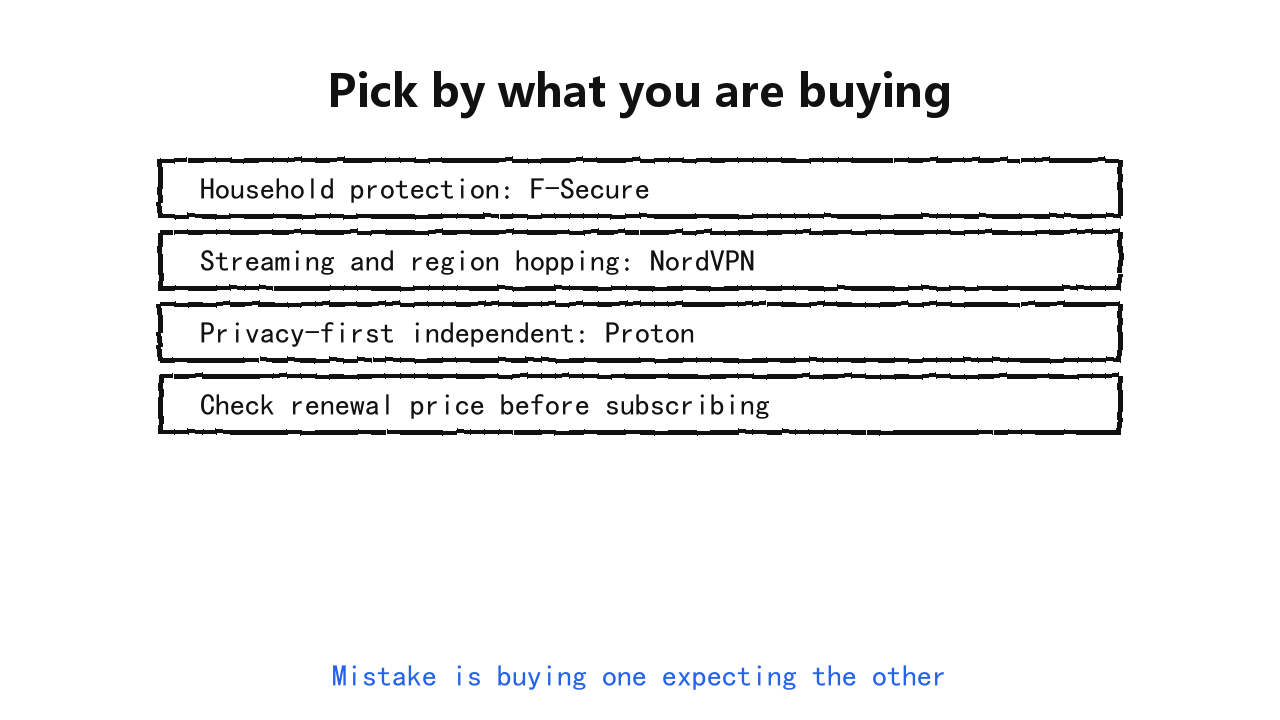
Pick F-Secure if you are buying for a household, want antivirus and privacy under one annual bill, and treat the VPN as a supporting feature rather than the main event. It is also the better fit if you are already inside the F-Secure ecosystem or need identity protection bundled rather than added later.
Pick NordVPN if the VPN is the point: you want the largest server network, the best streaming support, and the most mature app experience, and you are comfortable with add-ons being sold separately. If you are privacy-first and want an independent option instead of a suite, our NordVPN vs Proton VPN breakdown covers that trade-off in more detail.
One more consideration: the two overlap less than the marketing suggests. F-Secure’s strength is coverage; NordVPN’s strength is depth in one category. Deciding which one you need is really deciding whether you are buying a security bundle that includes a VPN, or a VPN that happens to sell bundles. Detailed plan breakdowns are in our F-Secure review and NordVPN review.
Verdict
For most people who specifically want a VPN, NordVPN is the stronger product. For households that want one security subscription with a usable VPN inside, F-Secure is the more coherent purchase. Neither is a bad choice — they are simply answering different questions, and the mistake is buying one while expecting the other.
Before you commit, check two numbers on the checkout page: the renewal price and the device limit. Those two determine whether the plan still makes sense in year two, and they differ more between these two vendors than the headline feature lists do. Start with F-Secure Total if the suite approach fits you, or NordVPN if you want the VPN to be the centerpiece.
FAQ
Is F-Secure’s VPN as fast as NordVPN?
No. NordVPN is faster on distant servers and more consistent for streaming. F-Secure’s VPN is adequate for browsing and privacy but is not tuned for throughput or region-hopping.
Does NordVPN include antivirus?
Only in a limited form through threat protection, which blocks malicious domains and downloads. It is not a full antivirus engine comparable to F-Secure’s, which is the main reason the suite comparison is not like-for-like.
Which is cheaper for a family?
F-Secure usually wins on household value because one annual license covers a set number of devices and includes protection beyond the VPN. NordVPN’s cost scales with device count and tier, so a large household often pays more.
Can I use both?
You can, and some people do: F-Secure for endpoint protection, NordVPN for streaming and travel. It is not the cheapest setup, but it avoids the compromise of choosing one company’s weak side.
Which has better streaming support?
NordVPN, clearly. Its server network and protocol tuning are built for it, while F-Secure’s VPN is designed for privacy rather than unblocking catalogues.
Are both safe to use?
Both are established European vendors with published privacy policies and no major logging scandals. NordVPN has more public third-party audits specific to its VPN; F-Secure’s assurances come bundled with its broader security compliance work.

King
Independent editors covering practical technology, online services and better buying decisions.